









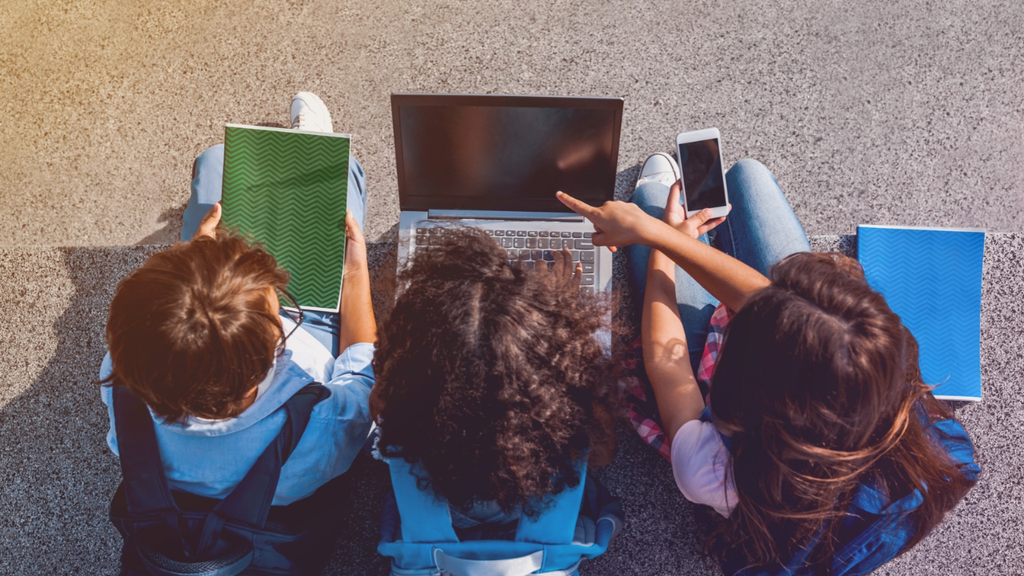
Two students each use one laptop for the same forty minutes in the same classroom. One joins a live algebra lesson taught by a credentialed teacher at a school across town. The other clicks through a video unrelated to the assignment. Both count as “screen time,” but only one is learning.
Most discussions about screen time overlook this distinction. Schools keep asking how many hours students spend on screens, when the more useful question is what they’re doing on them.
Table of Contents
The blanket-ban wave, and why it misfires
The pushback against classroom technology went mainstream in 2026. In April, the Los Angeles Unified School District board voted unanimously to build a districtwide screen-time limit for 2026-27, including a ban on district-issued devices in the early grades. At least six states passed classroom screen limits or bans the same year (K-12 Dive).
You can see why. Teens now average more than eight hours a day of entertainment screen media, and that’s before they walk into a classroom (Common Sense Media). Parents and school boards want a firm number to point to, a cap on how many hours a day students spend on screens.
The trouble is that a time cap can’t tell a distracting social feed from a live algebra class, because both of them glow. The U.S. Department of Education drew that line in August 2026. In new guidance, Assistant Secretary Kirsten Baesler wrote that instructional technology should be judged by what it does for learning, “not simply whether they happen on a screen” (U.S. Department of Education). Entertainment and instruction are two different problems, and the guidance says only the second one belongs in a learning plan.
What the evidence actually says
The same device, two opposite results
Start with the OECD’s 2022 PISA study of 15-year-olds. Students who used digital devices for learning up to an hour a day at school scored 14 points higher in math than students who didn’t use them at all (OECD, PISA 2022 Results Volume I).

Then look the other way. Students who said devices distracted them in most or every math lesson scored 15 points lower, which the OECD reckons is about three-quarters of a school year of learning. Roughly two-thirds of U.S. students reported that kind of distraction in math (Education Week). Leisure use tells the same story: students who spent up to an hour a day on devices for fun at school beat the ones who spent five to seven hours by 49 points in math (OECD, Managing Screen Time).
Same machines, same schools. What moved scores up or down was how students used them.
Moderate use beats both extremes
None of this is new. Ten years earlier, the OECD’s Students, Computers and Learning found that students who used school computers in moderation did a bit better than those who barely touched them, while heavy users did much worse, even after you account for background. Countries that had spent heavily on classroom tech saw no real gain in reading, math, or science (OECD, 2015).
Hardware without teaching changes nothing
UNESCO came to the same conclusion from a global perspective. Its 2023 report, Technology in education: A tool on whose terms?, found that some technology helps some learning in some settings, and that the benefit disappears once the tech is overused or handed out without a qualified teacher behind it (UNESCO GEM Report 2023).
For a school buyer, the lesson is where to put the money. A tool pays off when a trained teacher builds it into real lessons and gives it a clear job. Spend on that teaching, and the device earns its place in the classroom.
What purposeful use looks like in practice
Chicago Public Schools is the clearest recent example of doing this well.
Passing algebra by eighth grade sets a student up for advanced high-school math, all the way to AP Calculus. Plenty of CPS middle schools had no credentialed algebra teacher, though, so their students never got the shot. In fall 2020, the district started virtual Algebra Expanded Access Hubs: a credentialed teacher runs a live class over Google Meet for students sitting in schools that couldn’t offer the course themselves. Chromebooks and video, pointed at one specific problem (National Math Improvement Project).
The results are exactly what the federal guidance wants vendors to show. Schools offering algebra went from 213 in 2019 to 386. By 2024-25, 98% of schools with eighth-graders had at least one student sit the Algebra Exit Exam, 35% of eighth-graders took algebra, and more than 60% passed. And they kept up afterward: every eighth-grader who passed Algebra I in 2023-24 was passing the next math course a year later (K-12 Dive).
The equity numbers are the ones that stick. Participation among Black eighth-graders nearly doubled, from 11.3% to 20.6%, and their pass rate went from 31% to 43% in a single year (National Math Improvement Project; Chalkbeat).
Janice Jackson, the former CPS CEO, put it plainly on the DA Changemakers podcast: pull the technology out instead of teaching kids to use it well, and the ones who lose the most are the ones with the least support at home (District Administration). Chicago wasn’t adding screen time for its own sake. It was putting a qualified teacher in a room that didn’t have one.
Five questions to ask before buying any classroom tool
The guidance hands schools a filter that works on anything. Any education technology tool should be able to answer five questions (U.S. Department of Education):
- What learning problem does it solve?
- When should it be used?
- For whom?
- For how long?
- What evidence shows it improves student learning?
Four expectations sit behind those: a clear instructional purpose, independent evidence, honesty about how it’s designed and what data it takes, and real teacher training. If the best a product can do on question five is point you to a testimonial, you have your answer.
How teachers can design screen time on purpose
For teachers, the shift from limiting hours to using screens with purpose comes down to a few habits.
The first is to lean toward active over passive. A student learns more from a screen they build, write, or solve something on than one they just watch, so give the device a job that asks them to make something.
The second is shared over isolated. Thirty kids on thirty separate screens is thirty chances to wander off. Put the same thing on one display the class works through together, and attention stays in the room, where a teacher can actually read it. Collaborative work at the front of the room is often the fix for isolated device time, not more of it.
Then there’s the clock. Rogers Park Middle School in Danbury, Connecticut caps laptop math practice at 30 to 45 minutes a week and runs everything else on physical manipulatives and hands-on lessons (Education Week). The screen gets a job and a limit.
And when in doubt, device down. Bring screens out for the things paper can’t do: a simulation, a live remote lesson, a document a class edits together in real time, and put them away for everything else.
The standard applies to vendors too
That five-question test shouldn’t only be homework for schools. The people selling the tools should have to pass it too. The federal guidance asks providers to cut unnecessary screen time, and it puts the burden of proof on the product, not the classroom. A display, an app, a platform, any of them earns a place by helping a teacher teach and a student learn, and it should stay out of the way otherwise.
Frequently asked questions
How much screen time is appropriate in the classroom?
There’s no magic number, and chasing one is the wrong goal. PISA data links about an hour a day of device use for real learning to higher math scores, while distracted or heavy use pulls them down. Judge it by purpose and evidence, not a stopwatch.
Are screens bad for students?
A screen isn’t good or bad on its own; how you use it makes the difference. The same laptop runs a live algebra class or a distraction. The American Academy of Pediatrics leans on content and context over strict hour limits, especially for older kids (AAP).
What’s the difference between recreational and instructional screen time?
Recreational is entertainment: social feeds, games, off-task video. Instructional serves a specific learning goal with a teacher behind it. The Department of Education’s August 2026 guidance keeps them separate and says only the second belongs in a learning plan.
Should schools ban devices in class?
Banning recreational devices like personal phones has real evidence behind it for cutting distraction. Banning every screen is a different move, because it also strips out tools that widen access, like Chicago’s virtual algebra. A ban on distraction is defensible. A ban on instruction hits the students who can’t make it up at home.
How do we know if an edtech tool is actually working?
Ask that fifth question up front: what independent evidence shows it improves learning? Then watch real usage and outcomes once it’s in, and be ready to drop what isn’t helping. Judge a tool by what students actually do with it, not by what the contract promised.
